
The Christmas Star – The Star of Bethlehem 30.11.2024
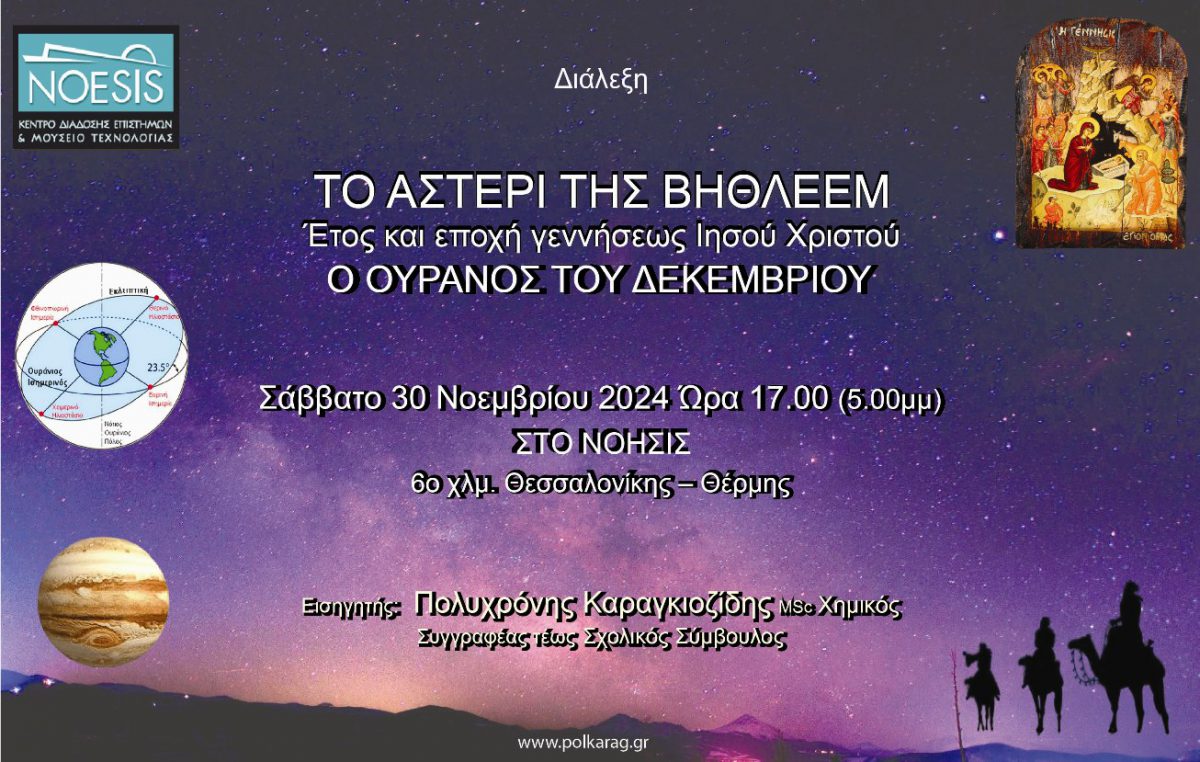
Live presentation at the Planetarium
A live presentation at the Planetarium, for the Star of Bethlehem, will take place on Saturday, November 30, 2024, at 17.00, by Polychronis Karagiozidis, Chemist MSc, Author, former School Counselor. The presentation takes place in the context of the Christmas tree lighting event and discussion on Artificial Intelligence and Industry. For more click here.
Free entrance.
Note by the rapporteur, Mr P. Kargiozidis
Year of Birth of Jesus Christ
As is well known, Dionysius the Younger, who lived in the 5th century AD, in his attempt to determine the beginning of the dates, committed two mistakes.
Mistake first: He assumed that Christ was born in 754 from the conquest of Rome, a year which does not correspond to the beginning of the dates “from the birth of Jesus Christ”, as shown below.
Historians, in their attempt to redefine the date of Christ’s birth, mainly use two historical data. One is related to Herod and the other to a population census.
According to the Evangelist Matthew, Christ was born during the reign of Herod. According to the Jewish historian Josephus, Herod was recognized by the Romans as king of Judea at the 184th Olympiad and was crowned king at the 185th Olympiad. The naval battle at Actium took place during the 7th year of the reign of Herod. Herod died after he had reigned for a total of 37 years. According to Matthew, Herod ordered the slaughter of infants “from two years old and below”. These data lead to the conclusion that Herod died in the year 4 BC and that Christ was born before the year 3 BC.
According to the Evangelist Luke, Christ was born when Joseph and Mary went to be enumerated. The Gospel passage states: “This census was the first to be made by the ruler of Syria, Cyrenius.” From the historical records we know that this census took place in 8 B.C.
From the foregoing, we conclude that based on historical references, Christ was born in the period after 8 B.C. and before 3 B.C.
At this point it should be mentioned that most historians consider that Christ was born between 7 BC and 3 BC.
The difference of one year, 8 BC or 7 BC, is not considered significant for events that took place 2,000 years ago. On the other hand, the censuses of that time, with the means they were conducted, could not possibly have been conducted simultaneously throughout the Roman territory.
Second mistake: It is interesting to mention the second mistake, even though it does not affect the year of birth.
If I ask you the following easy mathematical problem: “One historical event took place in 10 BC, and another event in 10 AD. What is the length of time between the two events?” If you answer: “20 years”, your calculation will be mathematically correct, but the result will be wrong, because:
As we had mentioned, Dionysius the Younger calculated that Christ was born in 754 after the conquest of Rome. He called this year “First Year after Christ” and the previous one, that is, 753 after the conquest of Rome, “First Year before Christ”. However, the difference from 753 to 754 is 1, while the difference from -1 to one is 2. For this reason, when we calculate the time span between events of which one took place before Christ and the other after Christ, we subtract 1 from our calculation.
Time of Birth of Jesus Christ
To determine the month of Christ’s birth we use the following historical references from the sacred texts.
1) A relevant passage of the Evangelist Luke states: “shepherds were in the same land, plowing and guarding the guards by night”.
We know that in the Palestinian region, shepherds and their herds remain in the countryside from the beginning of March to the end of October. Not in winter.
2) Another passage in the Gospel of Luke states that Jesus was born when Joseph and Mary went to Bethlehem to be enumerated. The censuses were not carried out during sowing and harvesting periods, and especially never in winter, due to difficulties in travel.
3) According to the scriptures (Omitted), King David had divided the annual service of priests in the temple into 24 on-call duty, each lasting 15 days. According to the Evangelist Luke, John the Baptist’s father, a priest Zechariah, belonged to the priesthood of Abijah. This on-call duty was the 8th in a row. The Jewish religious year began in the month of Nisan, which included part of March and part of April. During his time on duty, Zechariah was informed by the archangel Gabriel that he was going to become a father. During the 6th month of the pregnancy of Zechariah’s wife, Elizabeth, the archangel Gabriel announced to the Virgin Mary that she would become the mother of Christ. From these references we can assume that Christ was born during the month of September.
For many historians, the date of birth is placed between September 10 and October 5.
But why has December 25 been chosen as the day to celebrate Christmas?
As is well known, the determination of major holidays was mainly done in a conventional way.
1) Perhaps because the Church wanted to displace some ancient festivals, such as Saturnalia, which was celebrated from December 17 to 23 in honor of Saturn (Saturnus), and Brumalia, which was celebrated on December 25.
2) December 25 is after the winter solstice, during which the Sun takes the lowest meridian height and then rises towards the celestial equator. This phenomenon had symbolic significance in all ancient religions.
3) On the 25th of December the birth of the god Mithra was celebrated. It is a Persian deity, which during the reign of Emperor Aurelian, passed into Roman territory. Perhaps some have sought, apart from the displacement, something else because:
The god Mithra, in order to make it easier for people to communicate with him, was born as a man, from a virgin woman, the people killed him, he was resurrected and his birth was celebrated on December 25 of the Julian calendar.
The continuation at the Planetarium…